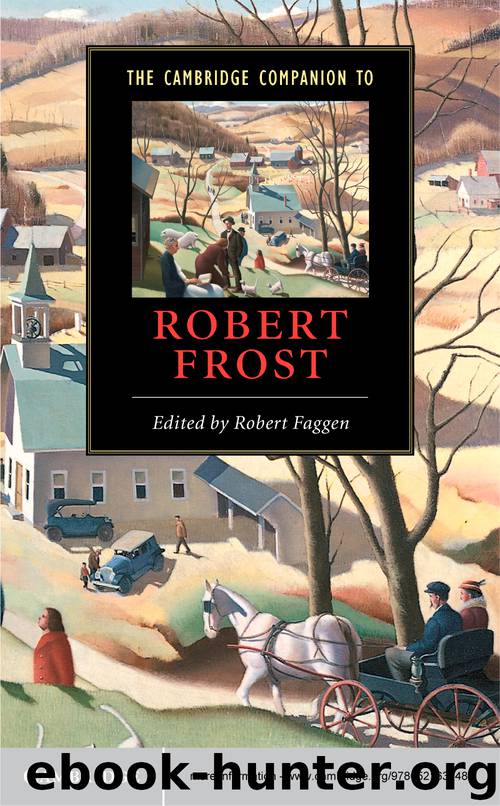
The Cambridge Companion to Robert Frost by Robert Faggen
Author:Robert Faggen
Language: eng
Format: epub
Publisher: Cambridge University Press
I’ll only stop to rake the leaves away
(“only” tone – reservation)
(And wait to watch the water clear, I may):
(supplementary, possibility)
I sha’n’t be gone long. – You come too.
(free tone, assuring)
(after thought, inviting)
(CPPP, 687, 688)
Although this is interesting analysis, it is unlikely that many readers, if asked to guess how many tones were in the stanza would answer five, or, if told that there were five, would guess them to be those Frost designates. If it be objected that his example ill suits his argument, and that it is hard to infer any but a sketchy context from the opening lines of a lyric poem, we might respond that even when poets minutely particularize their contexts, tone may remain elusive or subject to interpretation. For example, Shakespeare clarifies, with extensive circumstantial detail, the political and personal issues that surround Prince Hal, Hamlet, and Prospero, but fine actors have offered equally plausible but very different readings of these characters and of the tones appropriate to particular lines and passages.
Skeptical of Frost’s assertion that writers can precisely convey tone, Gamaliel Bradford remarks to the poet in 1924: “It is probable that every writer hears his own composition as well as sees it. But the subtle possibilities of variation in the matter are so wide, that I can hardly feel that you are right in feeling that any one interpretation out of many can possibly be imperatively indicated” (SL, 298–99). This seems a sensible assessment of the issue. Writers should compose, as Frost does so magnificently, with their ears sensitively attuned to the resources of the live voice. But it is overstating matters to demand that writing consistently specify vocal tone.
Frost himself sometimes appears to doubt his theory of the sound of sense. In discussing it, he keeps fiddling with his terminology in a way that suggests he cannot focus his meaning to his own satisfaction. What begins, in the first letter to Bartlett, as “the sound of sense,” becomes, in the second letter to Bartlett “sentence sounds.” And we may well feel that these phrases indicate somewhat different things – pure tone in the first case, sentence as tone in the second – even though Frost indicates in his letter of March 1915 to Braithwaite that the terms are synonymous: “[M]y conscious interest in people was at first no more than an almost technical interest in their speech – in what I used to call their sentence sounds – the sound of sense” (CPPP, 684). Other phrases Frost employs to indicate the sound of sense include “sound-posture” (e. g.,17), “vocal posture” (e. g.,18), “sentence tones” (e.g., CPPP, 690), and “vocal imagination” (e. g., CPPP, 789).
Moreover, in his February 1914 letter to Bartlett, Frost remarks of his ideas about tone, “This is no literary mysticism I am preaching”; and he says shortly afterwards, “I wouldn’t be writing all this if I didn’t think it the most important thing I know. I write it partly for my own benefit, to clarify my ideas for an essay or two I am going to write some fine day (not far distant)” (CPPP, 675, 677–78).
Download
This site does not store any files on its server. We only index and link to content provided by other sites. Please contact the content providers to delete copyright contents if any and email us, we'll remove relevant links or contents immediately.
4 3 2 1: A Novel by Paul Auster(12352)
The handmaid's tale by Margaret Atwood(7726)
Giovanni's Room by James Baldwin(7297)
Asking the Right Questions: A Guide to Critical Thinking by M. Neil Browne & Stuart M. Keeley(5734)
Big Magic: Creative Living Beyond Fear by Elizabeth Gilbert(5721)
Ego Is the Enemy by Ryan Holiday(5386)
The Body: A Guide for Occupants by Bill Bryson(5064)
On Writing A Memoir of the Craft by Stephen King(4909)
Ken Follett - World without end by Ken Follett(4703)
Adulting by Kelly Williams Brown(4549)
Bluets by Maggie Nelson(4533)
Eat That Frog! by Brian Tracy(4497)
Guilty Pleasures by Laurell K Hamilton(4417)
The Poetry of Pablo Neruda by Pablo Neruda(4077)
Alive: The Story of the Andes Survivors by Piers Paul Read(4009)
White Noise - A Novel by Don DeLillo(3987)
Fingerprints of the Gods by Graham Hancock(3974)
The Book of Joy by Dalai Lama(3958)
The Bookshop by Penelope Fitzgerald(3826)
